
Optimizing Geothermal Probe Field Size for a Cold District Heating Network
Summary: In this case study, GreenCity is used to compare three geothermal probe-field designs for a small residential neighborhood with a cold district heating network. The simulation evaluates 40, 55 and 70 double-U probe variants over several years of operation, showing how probe-field size affects backup boiler use, heat pump operation, source temperatures, network performance and electricity demand.
All three probe-field variants are technically feasible.
- The 40-probe variant requires more backup heat and relies more heavily on the air/water heat pump.
- The 55-probe variant provides the best balance between performance, reliability and efficient dimensioning.
- The 70-probe variant offers the highest robustness, but its additional benefit is limited, reducing electricity demand by only around 2%.
- The recommended design is the 55 double-U probe variant.
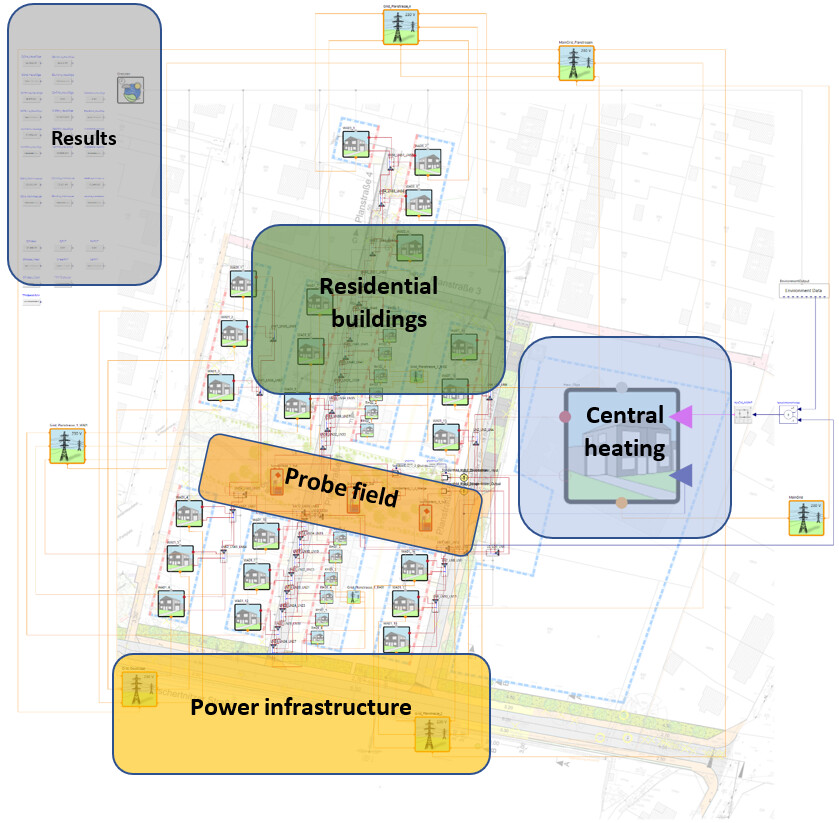
In the early planning phase of a neighborhood energy system, one key question is how large the geothermal probe field should be. A smaller field can reduce investment costs and space requirements, but may increase backup heat demand or reduce long-term operating robustness. A larger field can improve system stability, but may provide only limited additional benefit.
In this case study, GreenCity is used to compare three probe-field designs for a small residential neighborhood with a cold district heating network. The simulation evaluates 40, 55 and 70 double-U probe variants over several years of operation and shows how each design affects source temperatures, heat pump operation, backup boiler use, cold network performance and electricity demand.
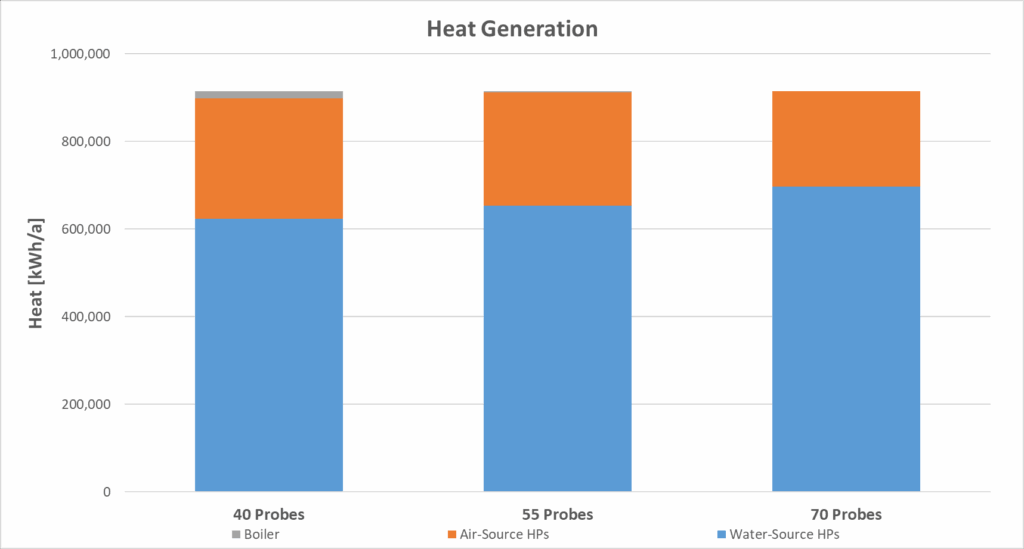
The simulation results show that all three probe-field variants 40, 55 and 70 double-U probes are technically feasible. The 40-probe variant requires slightly more backup heat and relies more strongly on the air/water heat pump, while the 55-probe variant provides a balanced solution with very low boiler use after several years of operation. The 70-probe variant offers the highest robustness, with almost no boiler heat and the lowest electricity demand, although the reduction in electricity use is only around 2%.
The cold network balance confirms that geothermal heat extraction is comparable across the variants, while peak capacity increases with the number of probes. Since the PVT area remains unchanged, both heat and electricity contributions from the PVT system are nearly identical in all cases. Overall, the comparison highlights the trade-off between a compact, cost-efficient probe field and a more robust but larger geothermal design.
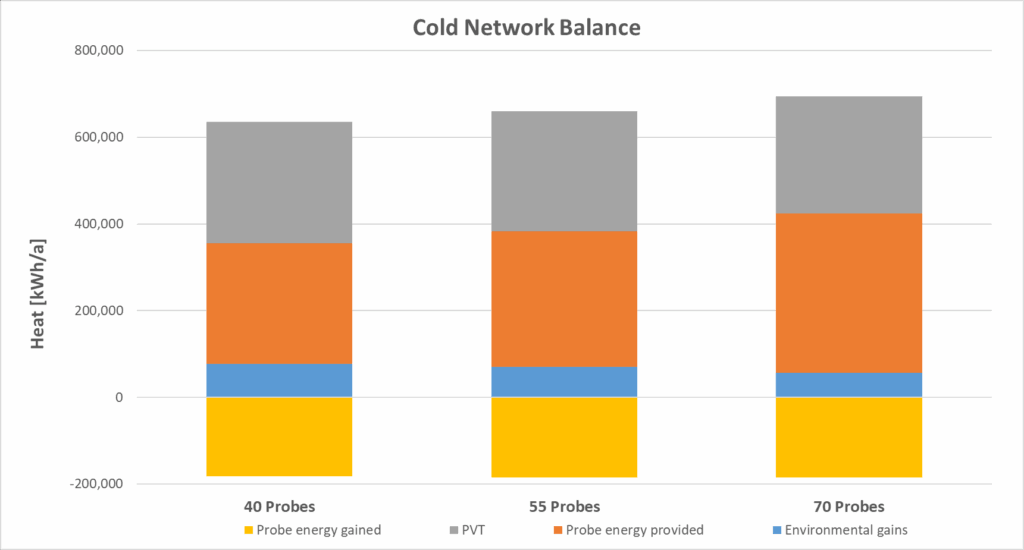
The simulation therefore provides more than a simple feasibility check. It supports concrete decisions on the appropriate size of the geothermal probe field, the role of the PVT area, the heat pump capacity and the required level of backup heat. At the same time, it helps identify overdimensioning, unfavorable operating states and low self-consumption shares at an early stage. Planners, operators and investors receive a transparent basis for comparing the 40, 55, and 70 probe variants and selecting a robust system configuration.
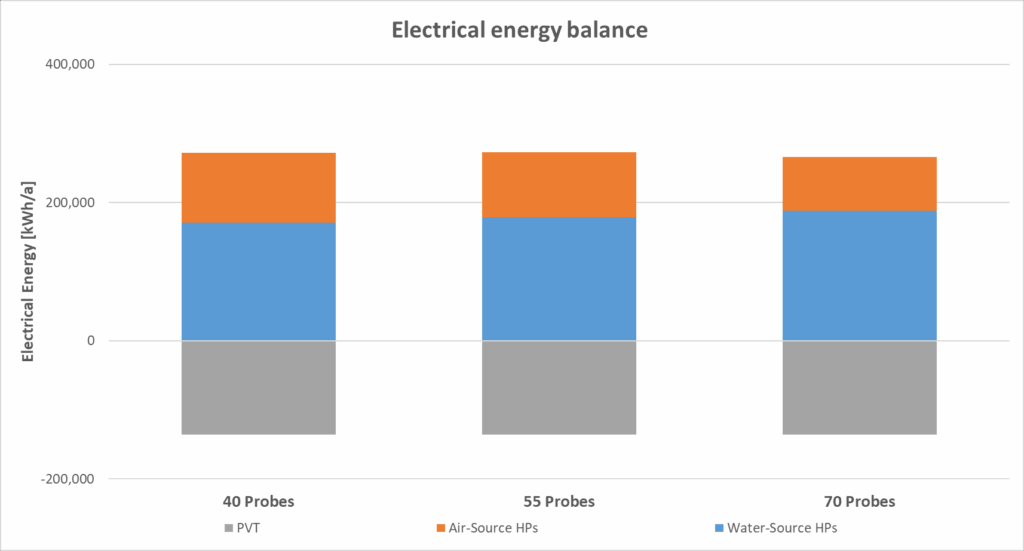
In conclusion, the 55 double-U probe variant was selected as the recommended design because it offers the best balance between technical performance, operational reliability and efficient dimensioning. Compared with the 40-probe variant, it reduces backup boiler use and dependence on the air/water heat pump, resulting in more stable long-term operation. Although the 70-probe variant provides slightly higher robustness, its additional benefit is limited, with only a small reduction in electricity demand, while requiring a larger probe field.